Ultimate Aptitude Test Practice Bank: Master Every Question Type
Are you preparing for a pre-employment screening? Do you want to understand your cognitive strengths and weaknesses before a critical job interview? Finding high-quality practice materials for an aptitude test can feel overwhelming. With so many different types of questions, it's hard to know where to begin.
We've designed this guide to build your confidence and ensure you walk into test day fully prepared. It’s your ultimate aptitude test practice bank. We have compiled a comprehensive collection of questions covering the most common categories you'll face. From logical reasoning to numerical ability, we will walk you through each type, providing clear examples and practical tips.
Before we dive in, remember that practice is only one part of the equation. Understanding your personal strengths and areas for improvement is just as important. You can get a baseline of your abilities right now with our scientifically designed aptitude test. It provides instant results and personalized insights to guide your career journey.
What is an Aptitude Test?
An aptitude test is a standardized assessment designed to measure your natural talent or potential to learn a specific skill. Unlike achievement tests, which measure what you already know, these types of assessments predict your future performance. Employers use them to evaluate a candidate's suitability for a particular role, focusing on abilities like problem-solving, critical thinking, and logical reasoning.
These tests are a reliable way for companies to screen large pools of applicants efficiently. They provide objective data that helps hiring managers identify candidates who have the cognitive abilities required to succeed in the job. For you, the test-taker, they offer a chance to showcase your raw talent beyond what’s on your resume.
Core Aptitude Test Categories and Practice Questions
Aptitude tests are not a one-size-fits-all tool. They come in various forms, each designed to measure a different cognitive skill. Below are the most common categories you will likely encounter, complete with practice questions to get you started.
Logical Reasoning Test Practice
Logical reasoning tests assess your ability to identify patterns, analyze arguments, and draw valid conclusions from information. These questions don't require prior knowledge; they measure your raw problem-solving skills.
-
Example Question: Find the next number in the series: 3, 6, 12, 24, ?
- A) 36
- B) 48
- C) 60
- D) 72
-
Answer and Explanation: The correct answer is B) 48. The pattern is to multiply the previous number by 2 (3 x 2 = 6; 6 x 2 = 12; 12 x 2 = 24). Therefore, the next number is 24 x 2 = 48.
Numerical Reasoning Test Practice
Numerical reasoning tests evaluate your ability to interpret and work with numerical data. This often involves reading charts, graphs, and tables to answer questions. You will need basic math skills like percentages, ratios, and averages.
-
Example Question: A company's revenue was $500,000 in 2022 and $650,000 in 2023. What was the percentage increase in revenue?
- A) 20%
- B) 25%
- C) 30%
- D) 35%
-
Answer and Explanation: The correct answer is C) 30%. The formula for percentage increase is:
((New Value - Old Value) / Old Value) * 100. So,(($650,000 - $500,000) / $500,000) * 100 = ($150,000 / $500,000) * 100 = 0.3 * 100 = 30%.
Verbal Reasoning Test Practice
Verbal reasoning tests measure your ability to understand, analyze, and interpret written information. You will be given a passage of text and asked to determine whether a statement is True, False, or Cannot Say based only on the information provided.
-
Example Passage: "AptitudeTest.me offers a suite of scientifically validated assessments for both individuals and organizations. While a free test provides instant results, users can opt for a premium AI-powered report that delivers in-depth analysis of their strengths and development areas."
-
Statement: The AI-powered report is included with the free test.
- A) True
- B) False
- C) Cannot Say
-
Answer and Explanation: The correct answer is B) False. The passage clearly states that users must 'opt for' the AI-powered report. This means it's a separate purchase, not included with the free version.
Abstract Reasoning Test Practice
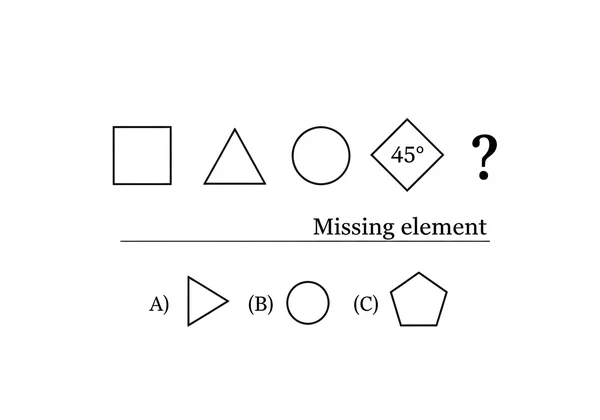
Abstract reasoning tests (also called inductive reasoning tests) examine your ability to recognize patterns and logic in sequences of shapes. This skill is crucial for roles that require strategic thinking and the ability to see the "big picture."
-
Example Question: You will see a series of five figures. Identify the pattern and choose which of the options completes the sequence. (Imagine a sequence where a square rotates 45 degrees clockwise in each step).
-
Explanation: To solve this, you must track the changes between each figure. Is an object rotating, changing color, or moving position? Focusing on one rule at a time is the best strategy. Consistent practice helps you spot these patterns much faster.
How to Prepare for Your Aptitude Test
Simply reviewing practice questions isn't enough. A structured preparation strategy will significantly improve your performance on any pre-employment aptitude test. Try these proven strategies to prepare more effectively:
Understand the Test Format
Before you begin, find out what kind of assessment you will be taking. Ask the recruiter about the test provider (e.g., SHL, Korn Ferry) and which skills will be measured. Knowing whether it's a numerical, verbal, or abstract reasoning test allows you to focus your practice on the right areas. Also, confirm if the test is timed and if you will be penalized for incorrect answers.
Use a Reliable Practice Platform
Consistent practice is the key to success. Using a platform that offers a wide range of questions helps you become familiar with different formats and difficulty levels. Regular practice builds mental stamina and improves your speed and accuracy. To discover which test types are most relevant for your career goals, you can start your test on our platform.
Simulate Real Test Conditions
When you practice, try to recreate the conditions of the actual test. Find a quiet space and set a timer based on the test's time limit. Make sure to avoid interruptions. This helps you get used to the pressure of a timed environment. It trains your brain to stay focused and manage your time effectively, ensuring you can answer as many questions as possible.
Review and Learn from Your Mistakes
After each practice session, don't just look at your score. Go back and review every question you got wrong. Understand why you made the mistake. Was it a calculation error, a misinterpretation of the question, or a gap in your knowledge? Learning from your errors is one of the most powerful ways to improve.
Frequently Asked Questions
What is a good score on an aptitude test?
A "good" score is relative and depends on the employer and the specific role. Companies often use percentile rankings, comparing your score to a benchmark group. Scoring above the 50th percentile is generally considered average, while a score in the 80th percentile or higher is usually seen as very strong.
How do I improve my speed in aptitude tests?
Improving speed comes from practice and strategy. First, become highly familiar with the question types so you don't waste time trying to understand the instructions. Second, learn to quickly identify and skip very difficult questions; you can return to them if you have time. Finally, practicing under timed conditions, like with an online aptitude test, will naturally increase your pace.
Are aptitude tests like IQ tests?
While they share similarities, they are not the same. IQ tests are designed to measure a person's general intelligence. An aptitude test is more specific, measuring your potential to succeed in a particular job or field. For example, a mechanical aptitude assessment measures your understanding of physical principles, a skill not typically covered in a general IQ test.
Can you fail an aptitude test?
You can't "fail" an aptitude test in the traditional sense, as there is no universal pass or fail mark. Instead, your score is compared to the scores of other candidates. If your score falls below the company's desired threshold for that role, you may not proceed to the next stage of the hiring process. The goal is to score as high as possible to stand out.
Your Next Step to Career Success
Feeling prepared is about more than just memorizing answers. It's about building confidence in your problem-solving abilities and understanding your natural talents. This practice bank gives you a solid foundation, covering the key question types you'll face on a typical aptitude test.
Regular practice with logical, numerical, and verbal reasoning questions trains your mind to spot patterns, analyze data, and maintain critical thinking under pressure. Remember to simulate real test conditions and learn from every mistake you make along the way.
Now it's time to put your knowledge into action. Ready to discover your current skill level and identify areas for growth? Take a real assessment to get personalized insights.
Take our free aptitude test today to get instant results and discover how our advanced AI reports can unlock your true potential and guide you toward the perfect career path.