The Science Behind Aptitude Tests: How Validity & Design Unlock Your Career Potential
Have you ever wondered what makes an aptitude test truly reliable? When you take an assessment to understand your career potential, the science behind it determines whether the results can genuinely guide your professional journey. A well-designed test isn't just a quiz; it's a carefully crafted tool built on decades of psychological research.
Let's explore the scientific foundations that make aptitude tests reliable tools for career guidance. By understanding how cognitive research and validation processes work together, you'll see why professional assessments provide insights you can truly trust. Understanding this science helps you see why a professionally developed aptitude test is a powerful step toward unlocking your potential.

Understanding Psychometric Validity in Aptitude Assessments
When we talk about an aptitude test, one of the most important concepts is "validity." In simple terms, validity answers the question: Does the test actually measure what it claims to measure? A valid test provides meaningful and accurate information about your abilities, making the results useful for career planning or job applications.
At its core, a valid assessment ensures that the conclusions drawn from your score are appropriate and well-founded. This is what separates a scientifically backed tool from a simple online quiz. It's the assurance that your results reflect your true capabilities in a specific area.
What Validity Really Means Beyond Simple Accuracy
Validity goes deeper than just getting questions "right" or "wrong." Accuracy simply confirms whether you solved a math problem correctly. Validity goes further—it determines if that problem actually measures your numerical reasoning skills relevant to a finance career.
A valid test connects your performance to real-world outcomes. For example, a valid mechanical aptitude test should successfully predict how well someone might perform in an engineering role. It isn’t about trick questions; it’s about creating an assessment that accurately reflects the skills needed for success.
The Three Pillars of Test Validity: Content, Criterion, and Construct
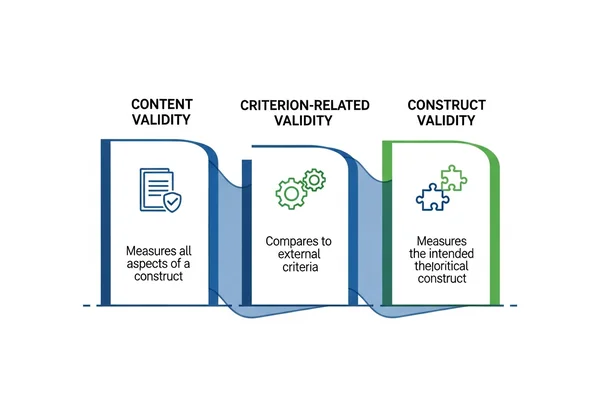
Psychometric experts, the professionals who design and validate tests, generally look at three key types of validity to ensure an assessment is robust and dependable.
-
Content Validity: This ensures the test covers all relevant aspects of the skill it's supposed to measure. For a verbal ability test, this means including questions on vocabulary, grammar, and reading comprehension—not just one of them. The content must be a comprehensive representation of the entire skill.
-
Criterion-Related Validity: This type of validity compares test scores with a specific outcome or "criterion." For instance, if high scorers on a pre-employment aptitude test consistently become top-performing employees, the test has high criterion-related validity. It successfully predicts job performance.
-
Construct Validity: This is perhaps the most complex pillar. It confirms that the test is truly measuring the underlying psychological concept (or "construct"), like logical reasoning or spatial awareness. It ensures the test isn't accidentally measuring something else, like reading speed or general knowledge.
Cognitive Science Principles That Shape Aptitude Test Design
Modern aptitude tests aren't just random collections of questions. They're carefully designed based on our understanding of how the human brain works. Cognitive science provides the blueprint for creating assessments that accurately measure thinking, reasoning, and problem-solving abilities.
By grounding test design in these principles, we can create assessments that are fair, challenging, and highly predictive of real-world abilities. This scientific approach is what makes a professional career assessment so valuable.
How Working Memory Tests Predict Professional Success
Working memory is your brain's "mental workspace"—the ability to hold and manipulate information for a short period. It's crucial for tasks like following multi-step instructions, solving complex problems, and staying focused.
Aptitude tests designed to measure working memory often use tasks that require you to remember and reorder sequences of numbers or letters. Research shows that a strong working memory is a powerful predictor of success in a wide range of jobs, from project management to software development. When a test measures this, it offers deep insight into your professional capabilities.
The Role of Executive Functions in Problem-Solving Assessments
Executive functions are a set of high-level mental skills that help you manage your thoughts and actions. They include planning, flexible thinking, and self-control. These skills are essential for navigating complex challenges and adapting to new situations.
Problem-solving assessments on an aptitude test are specifically designed to challenge your executive functions. Questions that require you to identify patterns, evaluate logical arguments, or devise strategies are all tapping into these core cognitive skills. A strong performance indicates a high potential for leadership and strategic thinking roles.

Reliability and Consistency: Ensuring Consistent Results Over Time
While validity ensures a test measures the right thing, reliability ensures it measures it consistently. A reliable aptitude test will give you a similar score if you take it on Monday and again on Wednesday, assuming your actual skill level hasn't changed.
Think of it like a trustworthy bathroom scale. If it shows a different weight every time you step on it within a few minutes, you can't trust the results. Similarly, a reliable test provides stable and consistent scores, giving you confidence that your results are a true reflection of your abilities. This is why a well-made career assessment is so important.
Internal Consistency: When All Test Questions Measure the Same Skill
Internal consistency refers to how well all the questions on a test work together to measure the same underlying ability. If a test is designed to measure numerical ability, every question should contribute to assessing that specific skill.
Designers use statistical methods to check that the questions are related and cohesive. If some questions are too easy, too hard, or measure a different skill entirely, they can be removed or revised. This process ensures that your final score is a pure and accurate measure of the intended aptitude.
Test-Retest Reliability: Proving Your Aptitude Profile Remains Stable
Test-retest reliability is exactly what it sounds like: it's a way of checking if a test yields consistent results over time. Researchers administer the same test to a group of people on two different occasions and compare the scores.
If the scores are very similar, the test has high test-retest reliability. This is crucial for aptitude tests because cognitive abilities tend to be stable over short periods. It gives you confidence that your test score isn't a random fluke but a stable measurement of your potential.
How Our AI Analysis Transforms Raw Scores into Actionable Insights
Getting a score is one thing, but understanding what it means for your career is another. This is where modern technology elevates the power of scientifically designed tests. At AptitudeTest.me, we use AI to transform your raw performance data into a personalized, actionable report.
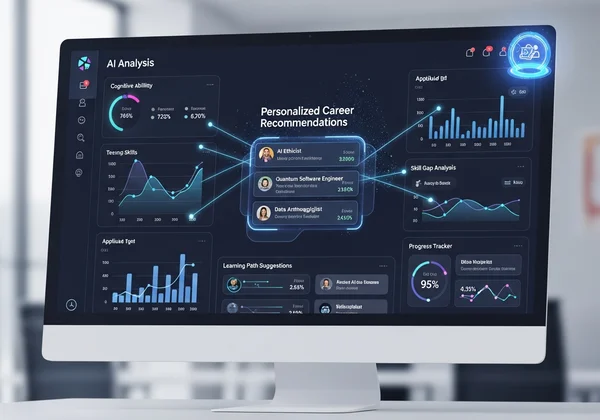
Our system goes beyond a simple number. It analyzes your unique pattern of responses to provide deep insights into your cognitive strengths, potential challenges, and how they align with various career paths. This is where science meets practical guidance.
Pattern Recognition in Cognitive Performance Data
The AI engine analyzes not just which questions you got right or wrong, but also the types of questions where you excelled or struggled. It looks for patterns across different cognitive domains, such as logical reasoning, verbal comprehension, and numerical skills.
For example, the AI might identify that you answer abstract reasoning questions quickly and accurately but are slower on detail-oriented tasks. This pattern provides a much richer picture of your cognitive profile than a single score ever could. You can discover these patterns when you take our test.
From Individual Strengths to Personalized Career Recommendations
The final step is translating these data-driven insights into practical advice. Based on your unique cognitive profile, our AI-powered reports offer personalized recommendations. They highlight your key strengths and suggest career fields where those abilities are in high demand.
The report also provides concrete suggestions for development, helping you turn potential challenges into opportunities for growth. It’s a roadmap designed to help you make more informed decisions about your professional future, all grounded in the principles of psychometric science.
Your Path to More Trustworthy Self-Assessment
The science behind aptitude tests is built on decades of psychometric research and cognitive science principles. Validity, reliability, and thoughtful design aren't just academic concepts—they're what ensure your assessment results can genuinely inform your career decisions. When you take our assessments, you're not just answering questions; you're engaging with tools developed through rigorous scientific validation to provide meaningful insights about your potential.
Experience science-backed assessment for yourself. Start your test today and let cognitive science illuminate your unique career path.
Frequently Asked Questions About Aptitude Test Science
What does an aptitude test actually measure?
An aptitude test measures your natural talent or potential to learn a specific skill. Unlike an achievement test, which measures what you already know, an aptitude test focuses on your inherent abilities in areas like logical reasoning, numerical skills, spatial awareness, and problem-solving. The goal is to predict your future performance in a particular role or field.
How do you ensure test questions don't contain cultural bias?
This is a critical part of modern test design. To minimize bias, test developers conduct rigorous reviews and statistical analyses. Questions are vetted by diverse expert panels to remove culturally specific language or scenarios. Furthermore, data is analyzed across different demographic groups to ensure that the test is fair and measures aptitude equally for everyone, regardless of their background.
Can aptitude test results change over time?
Core cognitive aptitudes are generally stable throughout adulthood. However, scores can improve with targeted practice and learning. For example, you can get better at numerical reasoning tests by practicing relevant math problems. While your fundamental potential remains relatively constant, your ability to apply that potential can definitely be sharpened.
What's the difference between reliability and validity in testing?
Think of it this way: validity is about accuracy (does the test measure the right thing?), while reliability is about consistency (does it produce the same results repeatedly?). A test can be reliable but not valid—for example, a scale that is consistently 5 pounds off is reliable, but not valid. A good aptitude test must be both.
How long does it take to validate a new aptitude test?
Validating a new aptitude test is a lengthy and meticulous process that can take months or even years. It involves several stages, including defining the construct, writing and reviewing hundreds of questions, pilot testing with sample groups, and conducting statistical analyses to establish validity and reliability. This commitment ensures the final product is a trustworthy tool for personal and professional development. You can experience the result of this careful work by taking our free aptitude test.