Skill Assessments: How to Measure Skills, Spot Gaps, and Plan Next Steps
Skill assessments help turn a vague question, "What am I good at?", into a clearer set of skills, evidence, gaps, and next steps. They can be useful for career exploration, student planning, hiring preparation, employee development, or a personal skills inventory. The best results do not label your whole future from one score. They help you compare what you can do now with what a role, course, or growth goal may require. If you want to connect ability feedback with broader career reflection, an aptitude testing and career clarity library can be one practical place to begin.
What Skill Assessments Actually Measure
A skill assessment is any structured way to evaluate a person's current ability in a defined area. Some assessments are formal tests with timed questions. Others are checklists, work samples, self-ratings, manager ratings, simulations, or portfolio reviews. The format matters less than the question it is trying to answer.
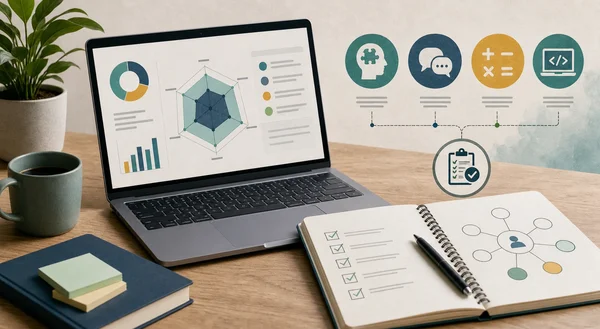
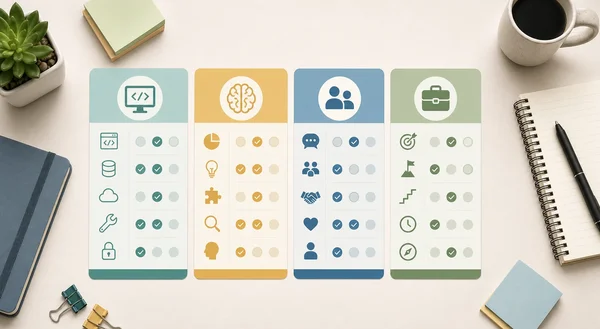
Most skills assessment tools fall into four broad groups:
| Area | What it may look at | Useful evidence |
|---|---|---|
| Technical skills | Software, coding, data, writing, equipment, procedures | Work samples, quizzes, task simulations |
| Cognitive skills | Reasoning, pattern recognition, numerical thinking, problem solving | Timed questions, case tasks, scenario questions |
| Soft skills | Communication, collaboration, leadership, adaptability | Behavioral examples, peer feedback, structured reflection |
| Career readiness | Interests, work values, transferable skills, learning goals | Inventories, guided worksheets, coaching notes |
This is why the phrase "skill assessments" can mean different things in different searches. A student may want a simple reflection worksheet. A job seeker may want a skills assessment test for employment. A manager may want an employee skill assessment that highlights training needs. An adult changing careers may need a broader career skills assessment that connects past experience to possible future roles.
Free, Online, PDF, Student, and Employment Formats Compared
Many people search for a skills assessment test free option because they want a low-friction starting point. Free skill assessments can be helpful when they explain what is being measured and give you a way to reflect on the result. They are weaker when they give a score with no context, no examples, and no suggestion for what to review next.
Online skill assessment tests are usually best when you want immediate scoring, interactive questions, and a clearer comparison between skill areas. A skills assessment PDF is better for offline reflection, classroom use, coaching conversations, or repeatable self-review. A skills assessment test free PDF can work well as a worksheet, but it should be treated as a planning aid rather than a complete measurement system.
Skill assessment tests for students often focus on learning habits, transferable strengths, subject readiness, and early career exploration. Skill assessments for adults usually need more room for work history, practical examples, previous training, and skills gained outside formal education. A skills assessment test for employment is narrower: it usually asks whether a person can perform tasks related to a role or training pathway.
How to Conduct a Skills Assessment Without Overclaiming
A useful assessment process starts before any test or worksheet. First, define the purpose. Are you exploring careers, preparing for an interview, planning training, or reviewing team capabilities? A broad purpose needs a broad assessment. A hiring or course-readiness purpose needs a narrower task-based approach.
Second, choose the skill categories. Keep them specific enough to act on. "Communication" is broad. "Explaining technical ideas to a nontechnical audience" is easier to observe. "Excel skills" is broad. "Using lookup functions, pivot tables, and charts to answer a business question" is more measurable.
Third, gather more than one type of evidence. Self-ratings are useful because they capture confidence and reflection. Work samples show performance. Timed questions can show speed and accuracy. Feedback from others can reveal patterns you may miss. No single method sees the whole person.
Fourth, separate scores from decisions. A low score in one area may show limited exposure, unclear instructions, test fatigue, or a real skill gap. A high score may show current strength, recent practice, or comfort with that format. Good assessment language stays modest: "This result suggests an area to review" is more useful than "This result proves your path."
For aptitude-related exploration, a structured aptitude test library can add another layer of evidence around reasoning, numerical ability, and problem-solving patterns. Use that evidence beside experience, interests, training history, and real-world performance.
Assessment Skills Examples That Make Results Easier to Trust
The strongest assessment skills examples are concrete. Instead of listing "leadership," write down the setting, the action, and the result. For example: "Led a weekly project check-in for six people, clarified blockers, and kept delivery on schedule for three months." That example is easier to evaluate than a bare label.
Try building a simple evidence matrix:
- Write the target skill in plain English.
- Add one example from work, school, volunteering, or personal projects.
- Rate your current confidence from low to high.
- Add one piece of evidence that supports the rating.
- Write one next practice task that would strengthen the skill.
This turns assessment from a static score into a learning loop. It also helps with job applications because you can connect your skills to examples. If you are assessing soft skills in candidates, the same principle applies: ask for behavioral evidence, compare answers to role-relevant expectations, and avoid vague personality labels.

Reading a Skill Gap Assessment as a Development Plan
A skill gap assessment compares current capability with a target. The target might be a job description, a training program, a promotion path, or a personal goal. The most useful result is not just a score. It is a ranked view of what to maintain, what to improve, and what to practice first.
Start with three buckets:
| Result pattern | What it may mean | Practical next step |
|---|---|---|
| Strong and relevant | A skill already supports your goal | Keep evidence updated and look for advanced tasks |
| Important but developing | A skill matters, but needs practice | Choose one training resource and one real task |
| Low relevance | A skill is weak or untested, but not central | Revisit later unless your goal changes |
This framing is especially useful for job skills assessment and employee skills assessment work. It keeps the conversation focused on development rather than judgment. It also helps prevent overtraining. You do not need to improve every skill at once. You need to identify the skills that matter most for your next decision.
A LinkedIn skill assessment or public badge can show one signal of ability, but it should not be your only evidence. Combine platform results with projects, examples, references, practice tasks, and role-specific expectations.
Turn Skill Assessment Results Into Career Clarity
After you complete a skill assessment, give yourself time to translate the result. Look for patterns across categories. Do technical strengths point toward a more specialized role? Do communication examples suggest customer-facing, teaching, management, or coordination work? Do reasoning scores suggest you may enjoy analytical problem solving? These are prompts for reflection, not fixed labels.
Then choose one next action. Update a resume bullet with a stronger example. Practice one weak area for two weeks. Compare your skills to one target role. Ask a mentor where your evidence seems strongest. Explore a role that uses your top two skill areas together. If you want another educational lens, you can explore a career clarity workflow and compare the feedback with your own experience.
Skill assessments are most valuable when they make the next step smaller and clearer. Treat them as a map draft: useful, imperfect, and meant to be checked against real terrain.
FAQ
What is a skill assessment?
A skill assessment is a structured way to evaluate current ability in a specific area. It may use tests, checklists, work samples, simulations, self-ratings, or feedback. The goal is to understand strengths, gaps, and possible next steps.
Are free skill assessments useful?
Free skill assessments can be useful for early reflection, especially when they explain the skill categories and provide practical next steps. They are less useful when they provide a score without context, examples, or limitations.
Can I use a skills assessment PDF?
Yes. A skills assessment PDF can be useful for classrooms, coaching, career planning, or offline self-review. It works best when it includes clear rating criteria, examples, and space to write evidence.
How are skill assessments for adults different from student versions?
Student versions often focus on learning readiness, interests, and transferable strengths. Adult versions usually need to include work history, informal learning, projects, role expectations, and skills gained outside school.
Is a LinkedIn skill assessment enough?
It can be one signal, but it should not stand alone. Pair it with work samples, portfolio evidence, role-specific practice, feedback, and examples that show how you use the skill in real situations.
How are skill assessments used for employment?
Employment-focused assessments usually compare a person's current ability with role tasks. They may support screening, training decisions, or interview preparation. The fairest use is specific, job-related, and combined with other evidence.