NJATC Aptitude Test: What to Expect and How to Prepare
The NJATC aptitude test is one of the first serious checkpoints many applicants meet on the way to an electrician apprenticeship. You may also see it described as the IBEW aptitude test, JATC aptitude test, electrical training alliance aptitude test, or electrical apprentice aptitude test, depending on the local program. The names vary, but the core search intent is usually the same: what is on the test, where do you take it, how is it scored, and how should you study without wasting time? If you are comparing electrician school, apprenticeship routes, and general ability testing, a broader career aptitude test library can also help you understand the reasoning and numerical skills behind these assessments.

What the NJATC Aptitude Test Is Really Measuring
The NJATC aptitude test is not a licensing exam and it is not a trade-knowledge final. It is a screening tool used by many electrical apprenticeship sponsors to estimate whether an applicant has the academic foundation and learning profile needed for apprentice training. That distinction matters because a strong prep plan should focus on core skills, not memorizing electrical code or trying to predict secret questions.
For many IBEW/NECA apprenticeship pathways, the commonly published test battery has two main parts: Algebra and Functions, and Reading Comprehension. Local programs may describe the process differently, especially if they use a broader general aptitude assessment or have local rules for prior experience. Always read the exact instructions from the local JATC, training center, or apprenticeship sponsor that scheduled your test.
In practical terms, the test is trying to answer three questions. Can you work with formulas, variables, number patterns, graphs, and basic functions under time pressure? Can you read a passage and extract accurate meaning without adding assumptions? Can you follow standardized instructions carefully enough to perform consistently in a structured training environment?
What the Test Usually Consists Of
The most common NJATC test descriptions list Algebra and Functions first. Public sample materials often show 33 questions with about 46 minutes. Topics can include evaluating formulas, simplifying expressions, recognizing number patterns, interpreting tables, understanding linear relationships, and working with graphs. You should be comfortable moving between a worded problem, an equation, and a table of values.
The second major section is Reading Comprehension. Public descriptions often show 36 questions with about 51 minutes. You read passages and answer questions about the main idea, details, inferences that are supported by the passage, and the meaning of specific statements. The challenge is less about advanced vocabulary and more about staying precise when the clock is moving.
Some applicants find online references to mechanical reasoning, spatial questions, motor coordination, or other assessment areas. That is where local variation becomes important. Some JATC pages describe a different general aptitude assessment with several areas, while many electrical training alliance style sample pages emphasize algebra and reading. Your local notice is the final authority for your appointment.

Where to Take the NJATC Aptitude Test Near You
Most applicants do not simply choose a random online testing site. The usual route is to apply through a local electrical apprenticeship program, JATC, electrical training center, or IBEW/NECA-related apprenticeship sponsor. After your application is accepted for review, the program tells you whether you are scheduled for the aptitude test, when to appear, what identification to bring, and whether any accommodation paperwork must be submitted in advance.
If you are searching “NJATC aptitude test near me,” start with the local apprenticeship sponsor rather than a generic testing center. Look for the program serving your trade goal, such as inside wireman, residential wireman, telecommunications installer-technician, or outside line work. Each track can have its own application window, eligibility requirements, interview process, and training schedule.
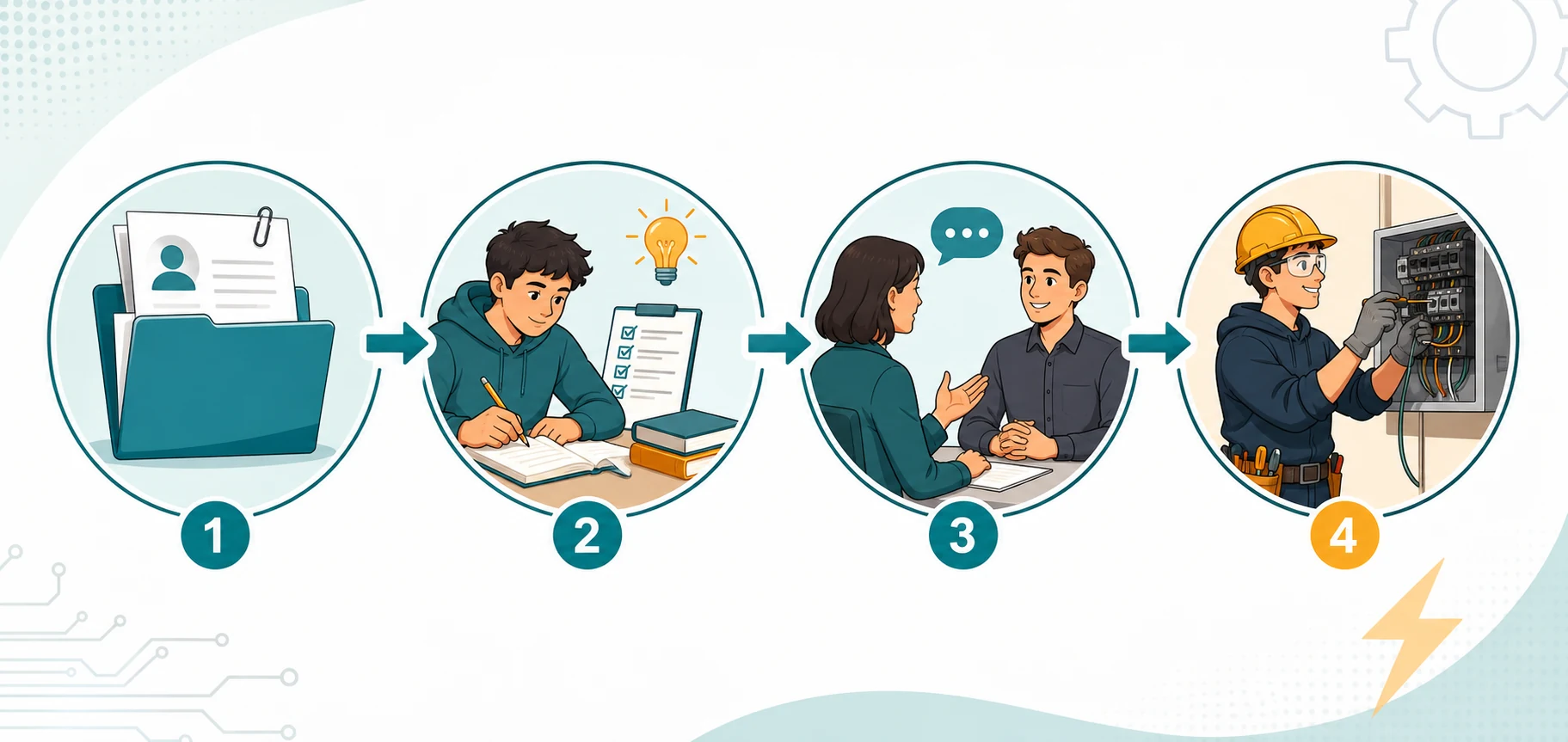
It also helps to keep a simple application folder. Save copies of your high school transcript or GED documentation, driver’s license or photo ID requirements, math course records, work history, and any messages from the training center. The aptitude test is only one step in a longer apprenticeship selection process, so missing documents can slow you down even if your study plan is solid.

NJATC Aptitude Test Scoring and Retake Rules
Scoring is one of the areas where applicants should be careful with Reddit threads, Quizlet sets, and old forum comments. Some local pages mention a qualifying score, such as a 4, before applicants move to an oral interview. Other programs describe results in broad categories or use different local reporting language. A score can determine whether you continue to the interview stage, but it usually does not exist in isolation. Applications, minimum qualifications, interview ranking, available openings, and program policies can all matter.
Retake rules also vary. Public local pages may mention waiting periods such as three months or six months before retesting. Your own program’s notice is the rule you should follow. Do not assume that a retake rule from another city applies to your local JATC.
If you do not pass or do not qualify for an interview, that result should be treated as feedback about one selection process, not a verdict on whether you can work in the trades. Use the waiting period to rebuild the underlying skills: algebra fluency, reading accuracy, pacing, and test-day discipline. Some applicants also gain relevant work experience, complete math review, or reapply during a later window.
A Practical NJATC Aptitude Test Study Guide
A good NJATC aptitude test study guide starts with the actual skill map. For algebra, review order of operations, signed numbers, fractions, ratios, linear equations, substitution into formulas, pattern recognition, slope-like relationships, and graph interpretation. Practice without a calculator if your local instructions say calculators are not allowed. That one detail changes the way you should study: mental arithmetic, scratch-work organization, and error checking become part of the skill.
For reading comprehension, use short nonfiction passages. After each passage, ask yourself four questions: What is the main point? Which details are explicitly stated? What inference is supported by the text? Which answer choice sounds plausible but goes beyond the passage? This habit is useful because many reading errors happen when you bring outside knowledge into a question that only wants passage evidence.
For timing, do not begin with full-speed practice. Start with accuracy, then add time pressure. If you rush too early, you may rehearse sloppy habits. Once your methods are stable, use timed sets that resemble the real sections. A mix of focused algebra review, reading drills, and general aptitude test practice resources can make your prep more structured, especially if you are also exploring other career or apprenticeship assessments.

Free Practice: What Helps and What Can Mislead
Free practice can be useful, but it should be chosen carefully. Strong practice questions train the same underlying skills as the test: algebraic reasoning, functions, patterns, tables, graph reading, and passage comprehension. Weak practice only copies the label “IBEW” or “NJATC” while drilling unrelated topics.
Quizlet can help with vocabulary or formula reminders, but it is rarely enough by itself because the test is about applying skills under time limits. Reddit can be helpful for hearing applicant experiences, but posts can be outdated, local to one program, or based on memory rather than official instructions. Treat community advice as a source of questions to verify, not as the rulebook.
A simple practice filter works well:
| Practice material | Useful if it trains | Be cautious if it |
|---|---|---|
| Algebra worksheets | formulas, tables, linear patterns, graph basics | depends heavily on calculators |
| Reading drills | main idea, detail, supported inference | uses trivia instead of passage evidence |
| Full timed sets | pacing and fatigue control | has unclear answers or no explanations |
| Forum advice | test-day logistics and morale | claims one local rule applies everywhere |
The best free routine is not glamorous. Do ten to fifteen algebra questions, review every miss, read one passage, explain why each wrong answer is wrong, and track the mistake type. Repeat that process often enough and your prep becomes measurable.
How to Pass the IBEW Aptitude Test With a Four-Week Plan
No study plan can promise an outcome, but a focused four-week plan can make your preparation more honest and less scattered.
Week one should be diagnostic in the ordinary study sense: find your weak areas. Take a small untimed set of algebra and reading questions. Sort every miss into a category, such as arithmetic slip, formula confusion, graph interpretation, main-idea error, or rushing. Then review the math basics that appear most often.
Week two should build algebra fluency. Practice substitution, simplifying expressions, solving one-variable equations, number sequences, and reading tables. Write out steps neatly. If you keep losing signs or copying numbers incorrectly, slow down and fix that habit before adding speed.
Week three should build reading precision and mixed practice. Alternate math sets with reading passages. For every reading question, underline the sentence that supports your answer. If you cannot point to support, reconsider the choice.
Week four should simulate test pressure. Use timed blocks, short breaks, and a quiet room. Practice the routine you want on test day: read directions, manage scratch paper, skip and return when stuck, and avoid changing answers without a reason. Two or three high-quality timed sessions are usually better than cramming random questions every night.
Test-Day Checklist for Apprentice Applicants
The day before your test, confirm the location, arrival time, parking plan, required identification, and any local rules about calculators, phones, watches, food, or bags. Many local instructions emphasize arriving early and bringing photo ID. If you need testing accommodations, contact the program before test day; same-day requests may not be possible.
On the test itself, protect attention. Read instructions exactly as given. In algebra, write clean scratch work and avoid doing too many steps in your head. In reading, answer from the passage rather than from memory or opinion. If a question is taking too long, mark it if allowed, move on, and return later. The goal is steady performance, not perfection on one stubborn item.
After the test, watch for official communication from your local program. Results may be sent by email, posted through an application system, or communicated by the training center. If you qualify, the next step may be an interview. If you do not, ask what the retake policy is and what timeline applies to your application.
Using Aptitude Results to Plan Your Electrician Path
The NJATC aptitude test is important because it can affect your apprenticeship application, but it is also a useful signal about the skills you will keep using in training. Electricians read technical materials, interpret measurements, reason through systems, follow exact procedures, and learn new concepts throughout their careers. Algebra and reading are not random hurdles; they support the work.
If your practice shows strong reading but weaker algebra, your next step is clear: rebuild math foundations before piling on more sample tests. If algebra feels comfortable but reading questions trip you up, slow down and practice evidence-based comprehension. If both areas feel inconsistent, a structured mix of aptitude testing support and local program guidance can help you turn vague worry into a concrete prep plan.
Most of all, use local instructions as your anchor. Names such as NJATC, JATC, IBEW aptitude test, and electrical training alliance aptitude test often overlap in search results, but your local apprenticeship sponsor controls the application details that matter for you.
FAQ
How hard is the NJATC aptitude test?
The test is challenging mainly because it combines algebra, reading accuracy, and time pressure. Applicants who have not used algebra recently may find the math section harder than expected. The reading section can also be demanding if you rush or answer from outside knowledge instead of the passage.
What does the NJATC aptitude test consist of?
Many commonly published versions include Algebra and Functions plus Reading Comprehension. Public sample descriptions often list 33 algebra questions and 36 reading questions, with each section timed. Some local programs may use different assessment descriptions, so check your own scheduling notice.
Where do I take the NJATC aptitude test?
You usually take it through the local apprenticeship program, JATC, electrical training center, or related sponsor after applying. Search for the program that serves your area and trade path, then follow its application and scheduling instructions.
How is the NJATC aptitude test scored?
Scoring details vary by local program. Some programs publish a qualifying score or broad result categories, while others communicate only whether you move forward. Ask your local training center how results are reported, how long they remain valid, and whether retake rules apply.
Can you still get hired if you fail an aptitude test?
A non-qualifying result does not mean you can never work in the electrical field. It may delay one apprenticeship application or require a retake after a waiting period. Use the time to improve algebra, reading, and application readiness, and check whether related entry routes or future application windows are available.
How do I pass the IBEW aptitude test?
Focus on the skills the test actually measures: algebraic reasoning, functions, number patterns, graph or table interpretation, and reading comprehension. Practice without relying on a calculator if your local rules prohibit one, use timed sets after you rebuild accuracy, and follow every instruction from your local program.
Is NJATC aptitude test Quizlet practice enough?
Quizlet can be a helpful supplement for quick review, but it is usually not enough by itself. You need applied algebra problems, passage-based reading questions, answer explanations, and timed practice. Use flashcards for reminders, not as your entire study plan.