My Interests and Skills: A Guide to Career Exploration
You might ask, “What are my interests and skills?” and find the answer surprisingly hard to explain. Maybe you enjoy solving problems but have never considered it a strength. Or you organize family plans with ease but overlook the skills involved.
Understanding what you enjoy and what you do well can make career exploration more manageable. You don't need to know your ideal job before you begin.
This guide offers practical reflection exercises, real-life examples, and a simple inventory to help you recognize your strengths. You'll also discover how exploring aptitude testing may add another perspective to your career journey, without deciding your future for you.

Interests, Skills, and Aptitudes: What Sets Them Apart?
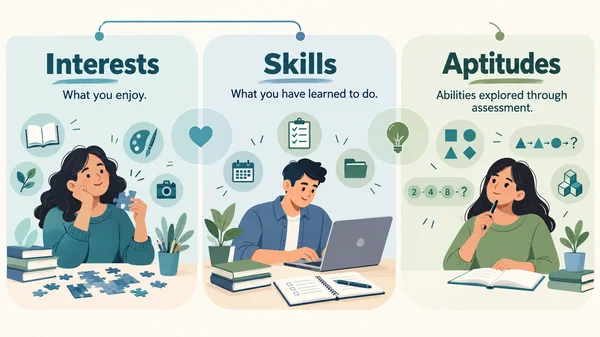
Your interests, skills, and aptitudes describe different parts of what you enjoy, what you can do, and how you approach certain tasks. Understanding these differences helps you make more informed choices about learning and work.
What Counts as an Interest?
An interest is something that attracts your attention or makes you curious. You might enjoy writing stories, repairing bicycles, helping friends, or learning about technology.
Interests don't require expertise. For example, you can love photography without knowing how to use a professional camera.
Your interests often offer clues about activities you'd like to explore further. However, enjoying an activity doesn't automatically mean you'll enjoy doing it professionally.
How Do Skills and Aptitudes Differ?
A skill is an ability you develop through learning, practice, and experience. Examples include writing clearly, organizing schedules, using spreadsheets, and solving technical problems.
An aptitude relates to your capacity to learn or perform particular types of tasks. Aptitude assessments provide information about selected abilities through performance on specific questions or activities.
| Concept | What it describes | Example |
|---|---|---|
| Interest | What you enjoy or want to explore | Enjoying puzzles |
| Skill | What you've learned to do | Solving spreadsheet problems |
| Aptitude | Capacity related to learning or performing certain tasks | Numerical reasoning |
These concepts can overlap, but they aren't interchangeable.
For instance, you might enjoy graphic design while still developing your technical skills. Similarly, you may perform well on numerical reasoning tasks without wanting a mathematics-focused career.
How to Recognize Your Personal Interests
If you're unsure what your interests are, begin with activities you already know. You don't need a detailed career plan to start.
Review Activities You Naturally Enjoy
Think about moments when you feel curious, engaged, or motivated.
Ask yourself:
- What subjects do I enjoy learning about?
- Which activities make me want to improve?
- What problems do I enjoy solving?
- What would I explore even without an external reward?
For example, perhaps you enjoy helping friends organize their schedules. That may suggest an interest in planning, coordination, or supporting others.
However, enjoyment alone doesn't prove that a particular career will suit you.
Find Patterns in School, Work, and Everyday Life
Next, review experiences from different parts of your life.
Consider school projects, hobbies, volunteering, household responsibilities, and previous jobs.
Look for themes that appear repeatedly. You might notice that you enjoy researching unfamiliar topics, creating visual designs, or organizing group activities.
Try this short reflection exercise:
- Write down five activities you enjoy.
- Identify what specifically appeals to you about each activity.
- Highlight interests that appear in multiple situations.
- Choose two interests you'd like to explore further.
Don't worry if your interests seem unrelated. You can enjoy both creative and analytical activities.
The goal is to notice patterns, not force yourself into a single category.
How to Identify Your Skills Through Real Experiences
Recognizing your skills can feel difficult, especially when you haven't had much formal work experience.
Fortunately, useful skills can develop through education, hobbies, volunteering, and everyday responsibilities.
Understand Hard Skills, Soft Skills, and Transferable Skills
Your skills may fall into several overlapping categories.
Hard skills involve specific learned abilities, such as spreadsheet analysis, programming, bookkeeping, or operating equipment.
Soft skills include communication, teamwork, adaptability, and time management.
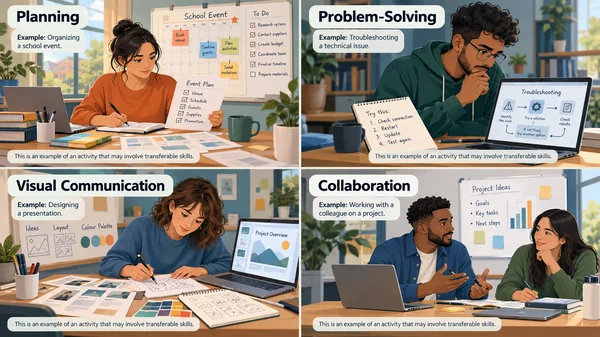
Transferable skills can support many different activities or jobs. For example, planning an event may strengthen organization and problem-solving skills.
One ability can belong to more than one category. Communication, for instance, is both a soft skill and a transferable skill.
Look for Evidence in Tasks, Projects, and Feedback
Instead of asking only what you're good at, think about what you've actually accomplished.
For example:
- You organized a group project and kept everyone informed.
- You explained a difficult concept to a classmate.
- You compared prices and managed a household budget.
- You learned unfamiliar software to complete a task.
Each example may offer evidence of a useful skill.
You can also review feedback from teachers, colleagues, or people who know your work.
However, specific observations are more useful than broad labels. Someone saying you explained a difficult idea clearly provides more information than simply calling you talented.
Distinguish Current Skills From Skills You Want to Develop
You don't need to be skilled at everything that interests you.
Separate your abilities into three groups: skills you use confidently, skills you're developing, and skills you'd like to learn.
This distinction can reveal opportunities for growth without making your current skill level feel permanent.
Practical Examples of Interests and Skills for Different Situations
Examples can make the connection between interests and skills easier to understand.
Your personal interests might involve creativity, technology, helping others, organizing activities, or solving problems. Meanwhile, the skills connected with those interests depend on what you've actually practiced.
Five Everyday Interests and Their Related Skills
The following examples show how ordinary activities may involve useful abilities.
| Personal interest | Related skill | Example activity |
|---|---|---|
| Writing | Written communication | Creating articles or newsletters |
| Technology | Technical problem-solving | Troubleshooting computer issues |
| Helping others | Listening and communication | Supporting a community project |
| Organizing | Planning and coordination | Arranging an event |
| Art and design | Visual communication | Creating presentations |
These connections aren't automatic.
For example, enjoying technology doesn't necessarily mean you have advanced technical skills. However, that interest may encourage you to develop them.
Examples for Students and Working Professionals
If you're a student, your interests and skills may appear through coursework or extracurricular activities.
Perhaps you enjoy science experiments and practice careful observation. Or you participate in a debate club and develop experience presenting arguments.
In a professional setting, your interests might include analyzing information, improving processes, collaborating with others, or solving customer problems.
Consider two hypothetical situations:
Student example: You enjoy organizing school events. Planning schedules, contacting participants, and coordinating activities may provide evidence of communication and organizational skills.
Workplace example: You enjoy investigating recurring problems. Reviewing information, comparing possible causes, and proposing improvements may demonstrate analytical thinking.
Rather than simply listing interests, describe what you actually did. This makes your personal inventory more meaningful.
How to Relate Your Interests and Skills to Career Options
Once you understand your interests and skills, you can begin exploring how they relate to different kinds of work.
You don't need to identify one perfect profession. Instead, look for career activities worth investigating.
Explore Different Career Interest Areas
Career interests describe the kinds of work activities or environments you prefer.
For example, you might enjoy:
- Creative activities: Writing, designing, or developing ideas.
- Analytical activities: Researching information or solving problems.
- Social activities: Teaching, collaborating, or supporting others.
- Practical activities: Building, repairing, or working with equipment.
- Organizational activities: Planning, coordinating, or improving processes.
These are illustrative categories, not a formal assessment system.
Some career frameworks group interests into specific categories. However, you don't need to fit neatly into one area.
Compare Your Interests With Real Job Activities
Next, look beyond job titles.
Research what someone actually does during a typical working day. Compare those responsibilities with activities you enjoy and skills you've developed.
For example, an interest in technology might connect to software development, technical support, data analysis, or digital design.
However, each occupation involves different tasks and requirements. Reviewing job descriptions or speaking with someone in the field can help clarify those differences.
Consider Work Values, Skill Development, and Practical Needs
Career exploration also involves values and circumstances.
You might prefer independence, collaboration, stability, flexible schedules, or continuous learning.
Additionally, consider training requirements, employment opportunities, and responsibilities outside work.
Your interests can guide exploration, while your skills and practical needs help you evaluate possible directions.
How Aptitude Assessments Can Support Career Exploration
Self-reflection provides useful clues, but it doesn't always reveal how you perform on particular reasoning tasks.
An aptitude assessment can offer another source of information to consider alongside your experiences.
What Aptitude Feedback May Help You Understand
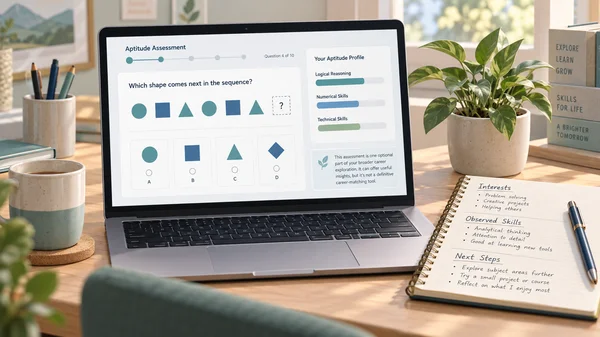
Aptitude assessments may examine selected abilities, including logical reasoning, numerical reasoning, and certain technical or cognitive skills.
For example, you might perform comfortably on numerical questions, even though you've never considered mathematics a major interest.
Alternatively, you might find some tasks challenging and decide to practice them further.
At AptitudeTest.me, you can review online aptitude test options designed to support ability awareness and career exploration.
The platform provides core scores and optional AI-powered reports that may help you reflect on strengths, challenges, and possible development steps.
These reports are informational resources, not substitutes for individualized professional career guidance.
Why Assessment Results Are Only One Part of Career Exploration
An aptitude score doesn't capture every skill you possess. It also cannot measure all your interests, motivation, experience, or personal circumstances.
Performance can depend on question familiarity, preparation, testing conditions, and other factors.
Therefore, consider assessment feedback alongside your own observations.
Ask whether the results suggest abilities you recognize or areas you'd like to explore further. Avoid treating one score as a fixed limit on your development.
Remember: Aptitude assessments are educational tools. They cannot determine your ideal career, guarantee employment, or replace professional career guidance.
Build Your Interests and Skills Inventory for Career Exploration
The question “What are my interests and skills?” becomes easier to answer when you record your experiences rather than relying on general impressions.
A simple inventory can help you organize what you've learned and identify practical next steps.
Create a Simple Four-Column Inventory
Use a notebook or spreadsheet to record four kinds of information:
| Interest | Skill | Evidence | Possible career activity |
|---|---|---|---|
| Writing | Clear communication | Created a school newsletter | Content development |
| Technology | Troubleshooting | Solved recurring computer problems | Technical support |
| Organizing | Planning | Coordinated a community event | Project coordination |
Create your own version using these steps:
- List your interests. Begin with activities you genuinely enjoy.
- Identify related skills. Include abilities you've practiced, not just qualities you admire.
- Record evidence. Describe something you completed, handled, or improved.
- Explore possible applications. Identify work activities that might use those skills.
- Choose one next step. Research, practice, or experience an activity before making a major decision.
Avoid treating this inventory as a permanent description of yourself. You can update it as you learn.
Choose One Career Activity to Explore
Pick one area that combines curiosity with a skill you have or want to develop.
For example, if you enjoy solving practical problems, you might try a small technical project or learn about related occupations.
You can also explore aptitude assessments for career discovery if you'd like additional information about selected abilities.
When an important career decision feels complicated, a qualified career counselor can help you consider your options and circumstances.
Your interests and skills are useful starting points, not fixed limits. Often, a small practical experience can teach you more than trying to choose your entire future at once.
Frequently Asked Questions
What Are 10 Examples of Interests?
Ten examples are reading, writing, music, sports, cooking, photography, technology, gardening, volunteering, and problem-solving. Each interest can involve different activities and skills. You don't need to turn every personal interest into a career opportunity.
What Is a Career Interest?
A career interest is a preference for certain work activities, topics, or environments. For example, you might prefer creative tasks, research, teamwork, or practical problem-solving. Career interests can guide exploration without determining one ideal profession.
What Are Examples of Professional Interests?
Professional interests may include data analysis, project coordination, teaching, customer communication, technical problem-solving, and creative development. These describe work activities that attract your attention. They don't necessarily indicate your current level of skill.
How Can I Identify My Interests Without Work Experience?
Start with school assignments, hobbies, volunteering, household activities, and personal projects. Notice which tasks you enjoy and why. You can also try unfamiliar activities to discover interests that your previous experiences haven't revealed.
Can My Interests and Skills Change Over Time?
Yes. Your interests may change as you encounter new experiences or develop different priorities. Likewise, skills can improve through learning and practice. Reviewing your inventory periodically can help you notice new abilities and changing preferences.
Can an Aptitude Test Tell Me Which Career Is Best for Me?
No single aptitude assessment can determine your ideal career. It may provide insights into selected abilities, but career fit also involves interests, values, experience, training, and personal circumstances. Use assessment results as one source of information rather than a final answer.