How to Find a Job You Love: A Step-by-Step Guide for 2026
You might know the feeling. The alarm goes off on Monday morning, and a wave of dread washes over you. You are not alone in this experience. Many professionals spend years wondering how to find a job you love while feeling stuck in roles that drain their energy.
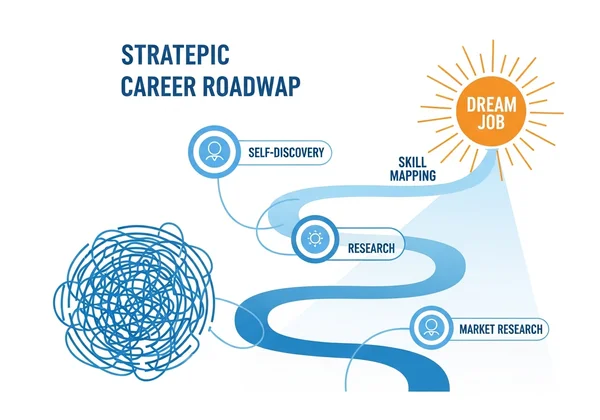
However, finding fulfilling work is not just about luck. It is not about waiting for a lightning bolt of inspiration, either. Instead, it is a structured process of self-discovery and market research. You can build a career that aligns with your natural strengths. Before you dive into specific listings or try the career aptitude test, you need a clear strategy.
This guide provides a roadmap to help you navigate this transition. We will move from confusion to clarity using actionable steps. You will learn how to identify what you want, validate your choices, and overcome common barriers like age or lack of experience.
Clarify What You Actually Want (Beyond "Follow Your Passion")
The most common advice you hear is to "follow your passion." Unfortunately, this is often terrible advice. Passions change, but your natural aptitudes tend to stay consistent. If you are struggling with how to find a job you love, start by looking at what you are good at, not just what you enjoy as a hobby.
Why "Passion" is Often a Trap (The Competence Loop)
Passion often follows competence. When you are good at something, you get positive feedback. As a result, you enjoy the work more. This creates a "Competence-Confidence Loop." Therefore, the search for a dream job should start with your skills, not just your emotions.
The 3-Circle Model: Interests, Aptitudes, and Market Needs
To find sustainable work, you must identify the intersection of three areas:
- Interests: What topics spark your curiosity?
- Aptitudes: What tasks do you perform with ease?
- Market Needs: What are employers willing to pay for?
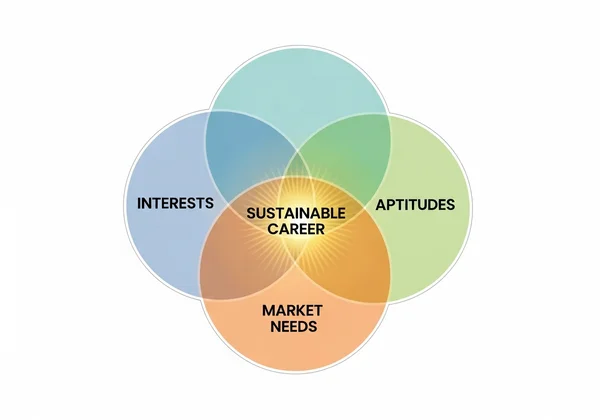
If you miss one circle, you run into problems. All interest and no skill leads to a hobby. All skill and no interest leads to boredom. High skill and interest but no market need leads to the "starving artist" trap.
Actionable Exercise: Separating Hobbies from Careers
Grab a notebook and create two columns.
- Column A (Hobbies): Things you do to relax (e.g., baking, gaming, reading). You do these for the process.
- Column B (Career Clues): Problems you enjoy solving (e.g., organizing data, mediating conflicts, fixing electronics). You do these for the outcome.
Focus your job search on Column B. This distinction is crucial when learning how to find a job you love.
The Data-First Approach: Using Tools to Uncover Hidden Strengths
Self-reflection has limits. You can only see yourself through your own biased lens. Sometimes, we undervalue our greatest strengths because they feel "easy" to us. This is where objective data becomes essential.
Subjective vs. Objective: Why Intuition Isn't Enough
Your friends might say you are "nice," but that doesn't tell you if you are suited for Nursing or HR. Objective assessments cut through the noise. They compare your traits against standardized benchmarks. This data provides a neutral baseline for your career planning.
Personality vs. Aptitude: Why "Who You Are" Isn't Always "What You're Good At"
There is a major difference between personality and aptitude.
- Personality describes your style (e.g., Introverted vs. Extroverted).
- Aptitude describes your cognitive potential (e.g., Logical reasoning, pattern recognition).
You might have an extroverted personality but a high aptitude for solitary, analytical work. Ignoring this mismatch often leads to burnout. Therefore, checking your cognitive profile with a comprehensive aptitude test online is a smart step. It helps align your daily tasks with your brain's natural wiring.
The "Data-First" Strategy: Using AptitudeTest.me for a Baseline
Before you rewrite your resume, gather your data. Use a reliable assessment tool to map your cognitive profile. This helps you narrow down industries. For example, if you score high in spatial reasoning, you might look at architecture or engineering. If you score high in verbal reasoning, marketing or law might be better fits. This data-driven approach removes the guesswork from how to find a job you love.

How to Find a Job You Love and Pays Well
A common fear is that doing what you love means taking a vow of poverty. This is a myth. You do not have to choose between happiness and a paycheck. You just need to be strategic about where you apply your skills.
Defining Your "Must-Haves" vs. "Nice-to-Haves" (Salary Non-Negotiables)
Be honest about your financial reality. Financial stress kills job satisfaction quickly.
- Must-Haves: Minimum salary to cover bills and savings, health insurance, commute time.
- Nice-to-Haves: Remote work, gym stipends, specific job titles.
Write these down. If a "dream job" doesn't meet your Must-Haves, it will eventually become a nightmare.
Researching Industries Where Your Strengths Are High-Value
The same skill pays differently in different industries. This is often referred to as "Industry Arbitrage."
- Example: "Writing" skills in a non-profit might pay $40k. The same skills in Tech (UX Writing) might pay $90k.
- Action: Take your top aptitude (e.g., organization) and search for "Highest paying jobs for organized people."
Don't guess at these numbers. Use resources like Glassdoor, Payscale, or government labor statistics to verify market rates. This research is vital. It answers the question of how to find a job you love without sacrificing your financial future.
Overcoming Barriers: No Experience or Changing Careers at 30+
You might feel discouraged if you lack experience or feel "too old" to switch. However, these barriers are often mental rather than actual dead ends.
Is It Too Late? (Navigating Career Change at 30, 40, and Beyond)
It is never too late. In fact, changing careers in your 30s or 40s is an advantage. You have soft skills that 20-year-olds lack. Employers value maturity, reliability, and emotional intelligence. You are not starting from zero; you are starting from experience.
Real-World Scenario: Jane’s Pivot from Education to Operations
Let's look at a concrete example to illustrate this. Meet Jane, a 35-year-old middle school teacher. After 10 years, she was burned out by the classroom environment but loved the organizational aspects of her job. She felt stuck, believing she was "only qualified to teach."
The Breakdown:
- Assessment: Jane took an aptitude test which confirmed high scores in Inductive Reasoning and Structural Visualization.
- Mapping: She realized these traits were perfect for Project Management.
- The Shift: Instead of applying for entry-level roles, she applied for "Junior Project Manager" roles in EdTech companies.
- The Result: Because she combined her domain knowledge (Education) with her aptitude (Management), she landed a role that paid 20% more than her teaching salary. She didn't start over; she pivoted.
The Transferable Skills Matrix: Mapping Old Skills to New Roles
Like Jane, you need to translate your old language into the new industry's language. Use this matrix to reframe your experience.
| Old Task (Teacher) | Transferable Skill | New Role Application (Project Manager) |
|---|---|---|
| Lesson Planning | Strategic Planning | Creating project roadmaps |
| Managing Classroom | Stakeholder Management | Leading team meetings |
| Grading/Feedback | Performance Analysis | Reviewing project metrics |
Leveraging "Potential" Over "Experience" in Interviews
When you lack direct experience, sell your potential. This is where your aptitude data helps again. You can confidently say, "I haven't used this software yet, but my assessment shows I learn systems 20% faster than average." This proves you are a high-ROI hire.
Validate Before You Leap (Low-Risk Experiments)
Do not quit your current job yet. The biggest mistake is jumping into a new career based on a fantasy. You must validate your hypothesis first.
Conducting Effective Informational Interviews
Find people who are currently doing the job you want. LinkedIn is a powerful tool for this. Send a polite message asking for 15 minutes of their time.
- Ask: "What is the worst part of your day?" (This reveals the hidden stressors).
- Ask: "What skills are most critical right now?"
- Avoid: Do not ask for a job. Ask for insight.
Job Shadowing and Short-Term Freelancing
If possible, shadow someone for a day. Alternatively, take on a small freelance project on the weekend.
- Does the work energize you or drain you?
- Do you like the people in this industry?
This "prototyping" phase is the safest way to learn how to find a job you love. It prevents buyer's remorse and ensures you are walking into a situation with your eyes wide open.

Final Thoughts on Your Career Journey
Finding the right career is a marathon, not a sprint. It requires patience, honesty, and a willingness to experiment. Remember, no job is perfect 100% of the time. However, a job that aligns with your natural strengths will feel significantly lighter and more rewarding.
If you are feeling stuck, stop guessing. Go back to the data. Start by understanding your core traits. You can explore our aptitude test to gain the clarity you need to take the next step. Mastering how to find a job you love is a journey worth taking, and your future self will thank you for the effort you put in today.
Frequently Asked Questions
How long does it usually take to find a job you love?
There is no fixed timeline. For some, it takes a few months of research. For others, it is a multi-year process of pivoting. Generally, plan for 3 to 6 months to identify a direction and another 3 to 6 months to land the role.
Will I have to take a pay cut to switch careers?
Not necessarily. If you leverage your transferable skills correctly, you can often enter a new field laterally. However, if you are moving to a completely unrelated industry, a temporary step back might be strategic for long-term growth.
Do career aptitude tests actually help find the right job?
Yes, they provide objective insights that subjective introspection often misses. They highlight your cognitive strengths, which are the best predictors of long-term job performance and satisfaction.
Is "loving your job" a myth?
If you expect to be euphoric every day, yes. However, if you define "love" as feeling competent, valued, and aligned with the work's purpose, then it is absolutely attainable. It is about deep satisfaction rather than constant fun.