How Do You Determine Work? Formula, Examples, and Aptitude Test Practice
If you searched "how do you determine work," you probably want a clear way to calculate work in physics. The short answer is that work depends on force, displacement, and the angle between them. In the simplest case, work equals force times distance. In real problems, you also need to ask whether the force points in the same direction as the motion, against the motion, or partly sideways. This guide explains the main formulas, common examples, friction, chemistry usage, and how these questions connect to structured aptitude practice for mechanical and numerical reasoning.

What Work Means in Physics
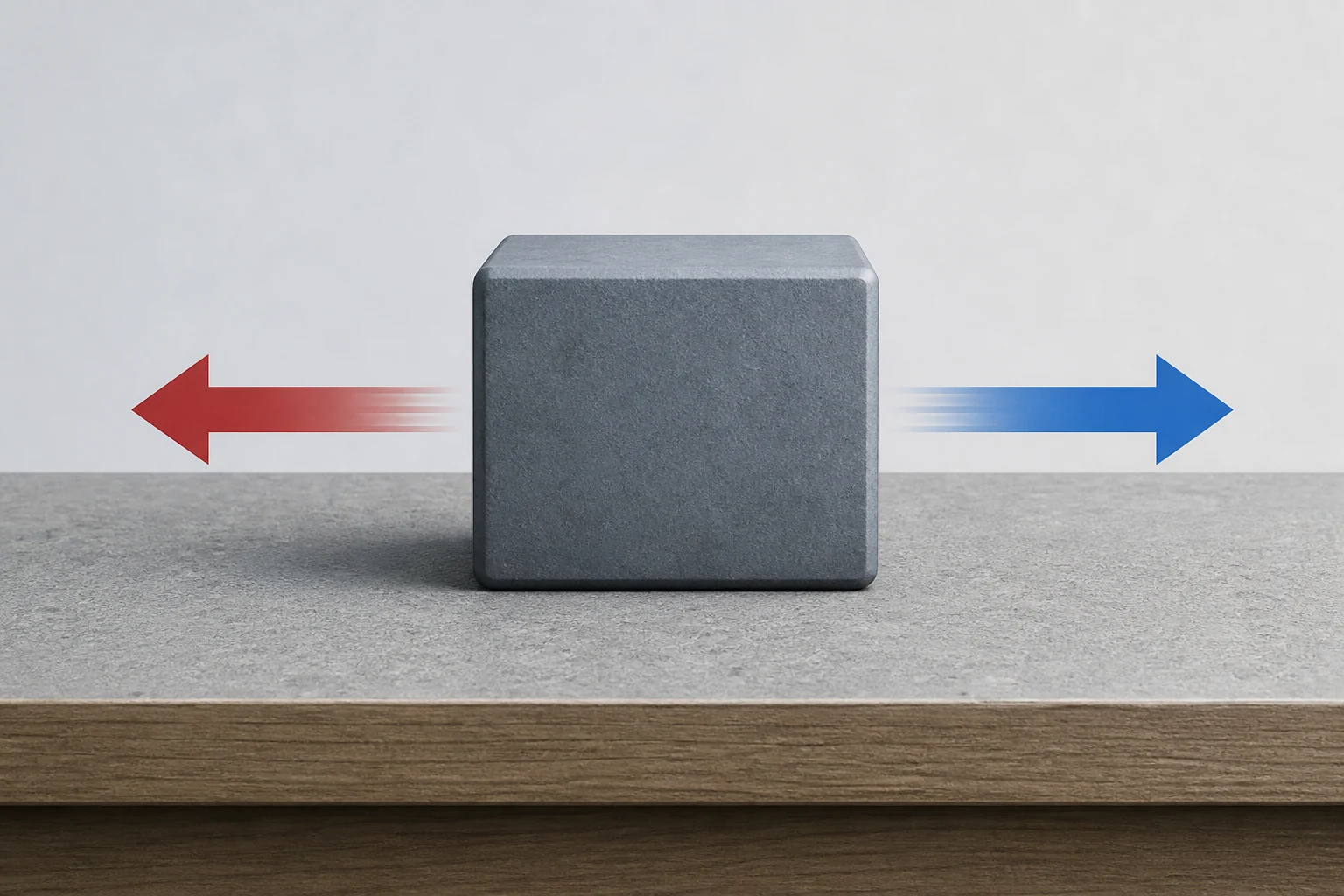
In physics, work is energy transferred when a force moves an object through a displacement. If you push a box and it moves in the direction you push, your force does positive work on the box. If friction resists the motion, friction usually does negative work. If a force acts at a right angle to the motion, that force does zero work because it does not move the object along its own direction.
This definition is narrower than everyday speech. Saying "I did a lot of work today" may refer to effort, attention, or time. In physics, effort alone is not enough. If you push hard on a wall and the wall does not move, the displacement is zero, so the mechanical work done on the wall is zero. That can feel counterintuitive, but it is exactly why these problems are useful for reasoning practice: you must separate ordinary language from measurable quantities.
The standard unit for work is the joule, written as J. One joule is the work done when one newton of force moves an object one meter in the direction of the force. Because work is a form of energy transfer, joules are also used for energy.
The Basic Formula: Work = Force x Distance
The simplest formula is:
W = Fd
In this formula, W is work, F is force, and d is displacement. Use it when the force and displacement point in the same direction.
Example: A person pushes a cart with a constant force of 40 N, and the cart moves 3 m in the same direction. The work is:
W = 40 N x 3 m
W = 120 J
That example uses the two measurements beginners need most: force and displacement. The force tells you how strongly the object is pushed or pulled. The displacement tells you how far the object moves in the relevant direction. If either value is missing, you cannot determine work from the basic equation alone.
A common mistake is to use total distance traveled when the question asks for displacement along the force. Suppose a person carries a bag horizontally across a room at constant height. The upward support force from the hand is mostly vertical, while the displacement is horizontal. For the upward force, the angle is close to 90 degrees, so that force does no mechanical work on the bag in the horizontal direction.

How to Calculate Work With an Angle
Many problems are not perfectly horizontal or vertical. When the force is applied at an angle, only the part of the force that points along the displacement does work. The formula becomes:
W = Fd cos(theta)
Here, theta is the angle between the force and the displacement. If the angle is 0 degrees, cos(theta) is 1, so the formula reduces to W = Fd. If the angle is 90 degrees, cos(theta) is 0, so the work done by that force is 0. If the angle is 180 degrees, cos(theta) is -1, so the work is negative.
Example: A rope pulls a sled with 50 N of force at a 30 degree angle above the horizontal. The sled moves 4 m horizontally. The work done by the rope is:
W = 50 N x 4 m x cos(30 degrees)
W = 200 x 0.866
W = 173.2 J
This is why drawing the angle matters. You are not asking, "How hard is the object being pulled?" You are asking, "How much of that pull acts along the movement?" In mechanical aptitude questions, the diagram often contains the clue. Read the direction of motion, identify the applied force, and then decide whether the full force or only a component belongs in the equation.
How to Calculate Work Done by Friction
Friction usually acts opposite the direction of motion. When kinetic friction slows an object, the work done by friction is often written as:
W_friction = -f_k d
The negative sign matters. It means friction removes mechanical energy from the moving object. For example, if a sliding box experiences 12 N of kinetic friction over 5 m, the work done by friction is:
W_friction = -12 N x 5 m
W_friction = -60 J
If the problem gives the coefficient of kinetic friction, you may first need to find the friction force:
f_k = mu_k N
On a level surface, the normal force N is often equal to the object's weight, mg, when no other vertical forces are involved. Then you can use that friction force in the work equation. Be careful on ramps or angled pulls, because the normal force may change.
Work by friction is a common bridge between formulas and interpretation. A positive applied work might speed an object up, while negative friction work reduces the energy available for motion. If the question asks for net work, add the work done by each relevant force with its sign.
Three Useful Work Formulas to Know
Students often ask for the "three formulas for work." The best set depends on the topic, but these three cover many introductory problems:
| Situation | Formula | When to Use It |
|---|---|---|
| Force is parallel to motion | W = Fd | A constant push or pull in the same direction as displacement |
| Force is at an angle | W = Fd cos(theta) | Pulling a sled, dragging a crate, or resolving force components |
| Net work changes speed | W_net = Delta KE | Work-energy theorem problems involving kinetic energy |
For the work-energy theorem, the net work equals the change in kinetic energy:
W_net = 1/2 mv_f^2 - 1/2 mv_i^2
This formula is useful when the problem gives mass and speed instead of a direct force and distance. It also helps when several forces act at once. You can calculate the total change in kinetic energy without separately finding every individual work term, as long as the problem gives enough motion information.
Chemistry uses a related but different convention for pressure-volume work. In many chemistry classes, expansion or compression work is written as:
w = -P_ext Delta V
That formula belongs to gases and thermodynamics, not a box sliding across a floor. Always match the formula to the course context.
When Search Results Mix Physics, Finance, and Career Work
The phrase "determine work" can point to several different intentions. Physics pages usually answer with force, distance, angle, and energy. Finance pages may discuss working capital, where a basic definition is current assets minus current liabilities. Career pages may discuss goals, priorities, skills, and job fit. Safety searches, such as the working load limit of welded steel chain, require manufacturer ratings, inspection guidance, and qualified safety procedures rather than guesswork.
If you are preparing for a test, identify the domain before choosing a formula. A worksheet asking for "work = force x distance" is physics. A business question asking for "net working capital" is finance. A career planning prompt asking how to determine your work goals is about decision-making, not joules. This quick sorting step prevents you from applying the right-looking formula to the wrong problem.
For aptitude test preparation, that sorting skill is part of the exercise. Mechanical and numerical reasoning questions often reward people who pause long enough to classify the problem type before calculating. You may find it helpful to review mechanical and numerical reasoning practice as a way to connect formulas with problem interpretation.
A Simple Method for Work Problems
Use this checklist when you need to determine work:
- Identify the object receiving the force.
- Write down the force in newtons.
- Write down the displacement in meters.
- Find the angle between the force and the displacement.
- Choose
W = FdorW = Fd cos(theta). - Add a negative sign when the force acts opposite the displacement.
- Use joules for the final unit.
- Check whether the question asks for one force's work or net work.
Here is a worked example:
A crate is pulled 6 m with a 30 N force at 0 degrees to the motion. Friction does -40 J of work. What is the net work?
First calculate the applied work:
W_applied = 30 N x 6 m
W_applied = 180 J
Then add friction:
W_net = 180 J + (-40 J)
W_net = 140 J
The net work is positive, so the crate gains kinetic energy overall. If the net work had been negative, the crate would lose kinetic energy overall. If the net work were zero, its kinetic energy would not change, even if individual forces were still acting.

Using Work Problems to Build Better Test Readiness
Knowing how do you determine work is not only about memorizing W = Fd. It is about reading a situation, choosing the right quantities, and checking whether your answer makes sense. Those are the same habits that support aptitude testing: slow down, notice the relationship between variables, and avoid treating every number in the question as equally important.
When you practice, mix straightforward force x distance examples with angle questions, friction questions, and work-energy theorem questions. After each answer, write one sentence explaining why the sign is positive, negative, or zero. That reflection turns calculation into reasoning. If you want a broader way to connect problem-solving patterns with career exploration, AptitudeTest.me's career clarity resources can be used as optional, educational support rather than a promise of any specific outcome.
FAQ
What is the formula to determine work?
The basic formula is W = Fd, where work equals force times displacement. Use it when the force and displacement are in the same direction. If the force is at an angle, use W = Fd cos(theta).
How is work calculated?
Work is calculated by multiplying the force by the displacement in the direction of that force. For angled forces, multiply by the cosine of the angle between force and displacement. The final unit is the joule.
What two measurements are needed to calculate work?
For the simplest formula, you need force and displacement. In many real problems, you also need the angle between them so you can determine how much of the force acts along the motion.
What are three formulas for work?
Three useful formulas are W = Fd, W = Fd cos(theta), and W_net = Delta KE. The first is for parallel force and displacement, the second is for angled force, and the third connects net work to a change in kinetic energy.
How do you calculate work done by friction?
When friction acts opposite motion, use W_friction = -f_k d. The negative sign shows that friction removes mechanical energy from the moving object.
Can work be zero even when force is applied?
Yes. Work can be zero if displacement is zero or if the force is perpendicular to the displacement. Pushing on a wall that does not move is a common example of force without mechanical work.
Is work the same in physics and chemistry?
The idea is related, but the formulas can differ. Introductory physics often uses force and displacement. Chemistry often discusses pressure-volume work for gases, such as w = -P_ext Delta V, depending on the course convention.