Aptitude Test vs. IQ Test: What Matters for Your Career?
Ever wondered about the real difference between an aptitude test and an IQ test? They sound similar, and both seem to measure intelligence, leading to a common point of confusion for job seekers and self-improvers alike. So, are they the same? The short answer is no. While both are valuable psychological tools, they serve fundamentally different purposes, and understanding this distinction is crucial for your career journey.
Let's break down these two assessments to uncover their true value. We'll explore what each test measures, how they differ, and most importantly, which one truly holds the key to unlocking your professional potential. By the end, you'll know exactly how an aptitude test provides the specific, actionable insights needed for today's competitive job market. Ready to discover your unique strengths? You can explore your potential with a professionally designed assessment today.
Understanding Aptitude Tests: Measuring Specific Skills for Success
Think of an aptitude test as a specialized toolkit. Instead of a single, broad score, it measures your potential to acquire specific skills. Employers value these tests because they accurately predict future performance in a particular role. It’s not about general intelligence; it’s about having the specific cognitive wiring to excel at certain tasks.
These practical, future-oriented tests reveal your inherent strengths in workplace-relevant areas, providing a roadmap for career selection and development. They answer specific questions, like whether you have a natural talent for numbers or if your logical reasoning is sharp enough for a programming role.

What Do Aptitude Tests Really Measure for Job Performance?
An aptitude test zeroes in on the specific abilities critical for success in a job. Unlike an exam testing what you’ve learned, it evaluates your raw potential to learn and apply new information. The results give employers a powerful glimpse into how you think, process information, and solve problems.
Commonly measured aptitudes include:
- Numerical Reasoning: Your ability to interpret and work with data, charts, and figures. Essential for roles in finance, engineering, and data analysis.
- Verbal Reasoning: Your capacity to understand, analyze, and draw logical conclusions from written information. Crucial for law, marketing, and communication roles.
- Logical Reasoning: Your skill in identifying patterns, sequences, and relationships in abstract information. A key indicator for success in tech and strategy-focused jobs.
- Spatial Reasoning: Your ability to visualize and manipulate 2D and 3D objects mentally. Vital for careers in architecture, design, and engineering.
Common Types of Pre-Employment Aptitude Tests
Since they are tailored to job roles, there are many types of pre-employment aptitude tests. Companies combine these assessments to build a profile of their ideal candidate. For example, a software engineering candidate might take logical and numerical tests, while a marketing applicant might face verbal and situational judgment tests.
A modern job aptitude test creates a fair, objective, and data-driven hiring process. It moves beyond a resume to assess a candidate's cognitive foundation to thrive. Understanding your own aptitudes lets you confidently target roles where you’re primed to excel. Find out where your talents lie by taking a free career test.
Unpacking IQ Tests: What General Intelligence Really Means
If an aptitude test is a specialized toolkit, an Intelligence Quotient (IQ) test is a general-purpose measuring tape. Its goal is to assess "general intelligence" or "g factor"—a broad intellectual capacity influencing performance across many cognitive tasks. An IQ score is a standardized number comparing an individual's reasoning ability to their age group's statistical average.
Originally for educational and clinical psychology, IQ tests measure abstract reasoning and academic problem-solving. They provide a single, comprehensive score representing overall cognitive horsepower.

The Concept of General Intelligence and Its Assessment
The idea behind IQ testing is that general intelligence can predict a person's ability to learn and adapt. Assessments like the Stanford-Binet or WAIS include subtests covering vocabulary, general knowledge, pattern completion, and memory recall.
These scores are compiled into one aggregate number. While useful in academic or clinical settings, its professional application is debated because it often fails to capture the multifaceted nature of workplace success.
Limitations and Real-World Application of IQ Scores
The biggest limitation of an IQ score in a career context is its generality. A high IQ doesn't guarantee you'll be a great team leader, creative designer, or meticulous accountant. Modern workplace success depends on a blend of specific cognitive skills, practical knowledge, and emotional intelligence—none fully captured by a single IQ score.
Furthermore, IQ is relatively stable in adults, offering little insight into your growth potential. It tells you where you are; an aptitude test tells you where you could go. This is why innovative companies now focus on assessments measuring job-relevant capabilities.
Aptitude Test vs. IQ Test: Key Distinctions for Your Career Path
With a clear understanding of each test, the distinction becomes obvious and has profound career implications. Choosing the right assessment is the difference between wandering aimlessly and navigating your professional life with confidence. A quality cognitive aptitude test is designed for exactly this purpose.
The core differences lie in their purpose, focus, and predictive power for job success. Recognizing these will empower you to use the right tool to build the career you desire.
Purpose, Focus, and Practical Application Differences
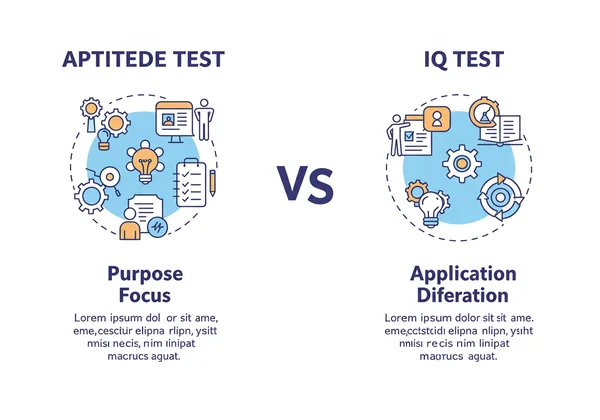
Here's a breakdown of the key differentiators:
-
Purpose:
- Aptitude Test: To measure your potential to succeed in a specific area or job role. It is predictive and forward-looking.
- IQ Test: To measure your general intellectual ability compared to a population average. It is a broad diagnostic tool.
-
Focus:
- Aptitude Test: Narrow and deep. It focuses on distinct skills like numerical, verbal, or logical reasoning.
- IQ Test: Broad and general. It combines multiple cognitive functions into a single score.
-
Application:
-
Aptitude Test: Widely used in recruitment, career guidance, and personal development to match people with suitable roles and training paths.
-
IQ Test: Primarily used in educational and clinical settings for diagnosing learning disabilities or identifying gifted individuals.
-
Predictive Power: What Works Best for Job Success?
Research and real-world practice show that aptitude tests are superior for predicting who will excel in a particular job. An employer hiring a financial analyst values exceptional numerical reasoning skills far more than a general IQ score.
Aptitude tests provide actionable data, helping companies build stronger teams by hiring people with people with the right inherent skills. For you, they offer a clear picture of your natural talents, helping you find a career that feels like a natural extension of who you are. To see how your skills stack up, you can try a free test on our platform.
Which One Matters More: Choosing Your Career Assessment Test
For anyone building a successful career—whether a recent graduate, a professional switching roles, or someone passionate about self-improvement—the choice is clear. A career assessment test focusing on specific aptitudes is infinitely more valuable than a general IQ score.
It’s the difference between having a vague idea of your destination and having a detailed GPS that guides you turn-by-turn. Aptitude tests provide that detailed guidance, helping you make informed decisions about your professional future.
Leveraging Aptitude Tests for Job Applications and Hiring Decisions
For job seekers, understanding your aptitude profile is a strategic advantage. It allows you to:
- Target the Right Roles: Apply for jobs that align with your natural strengths, increasing your chances of success and job satisfaction.
- Prepare Effectively: Practice specific types of aptitude questions to feel more confident during pre-employment screening.
- Highlight Your Potential: Showcase your scores or insights from an assessment to demonstrate your suitability for a role, even if your resume lacks direct experience.
For HR professionals, these tests are indispensable for making objective, effective hiring decisions and reducing bias.
How Aptitude Tests Guide Career Development and Self-Discovery
Beyond job hunting, aptitude tests are powerful tools for lifelong career development. By taking a comprehensive career aptitude test, you can uncover hidden talents or confirm suspected strengths. This knowledge empowers you to:
- Choose the Right Educational Path: Select a major or certification program that plays to your strengths.
- Identify Skill Gaps: Recognize areas where you may need additional training to reach your career goals.
- Explore New Career Paths: Discover professions you may have never considered but for which you have a strong natural aptitude.
This journey of self-discovery is the first step toward building a truly rewarding career.

Empowering Your Career Journey with the Right Assessment
While both aptitude tests and IQ tests measure cognitive abilities, they are not interchangeable. An IQ test offers a broad snapshot of your general intelligence, but an aptitude test provides a high-resolution map of your specific professional potential. It's a practical, actionable tool designed to empower you to navigate your career with clarity and confidence.
By focusing on your unique aptitudes, you can align your professional path with your innate talents, leading to greater success, fulfillment, and growth. Don't leave your career to chance. Take the first step toward understanding your strengths and unlocking your full potential.
Discover what you're truly capable of. Take a free aptitude test on our platform today and receive instant results, followed by an optional, in-depth AI report designed to guide you toward a brighter professional future.
Frequently Asked Questions About Aptitude & IQ Tests
Is an aptitude test exactly like an IQ test?
No, they are different. An aptitude test measures your potential to learn and perform in a specific area (like numerical or verbal reasoning), making it highly relevant for jobs. An IQ test measures general intelligence with a single score, which is less predictive of success in a particular role.
What specific aspects does an aptitude test measure?
An aptitude test measures specific cognitive abilities that are critical for different job functions. These often include logical reasoning, numerical ability, verbal comprehension, spatial awareness, and problem-solving skills. The goal is to see if you have the raw talent to excel in a role, separate from your current knowledge.
How can taking an aptitude test benefit my career?
Taking an aptitude test can profoundly benefit your career by providing clear, objective insights into your natural strengths. This helps you choose a career path where you're likely to succeed, prepare effectively for pre-employment screenings, and identify areas for personal development. You can discover your strengths and make more informed career decisions.
Who is the ideal candidate for taking an aptitude test?
Anyone interested in career growth is an ideal candidate! This includes recent graduates trying to find their direction, professionals considering a career change, and individuals focused on self-improvement who want to understand their cognitive strengths and weaknesses. HR professionals also use these tests to screen applicants.
What's the main difference between an achievement test and an aptitude test?
The main difference is what they measure. An achievement test measures what you have already learned (e.g., a final exam in a history class). An aptitude test, on the other hand, measures your potential or natural ability to learn a new skill in the future, regardless of your past education.