Ace Your Aptitude Test: 10 Logical Reasoning Practice Questions
Feeling challenged by logical reasoning tests? You're not alone. These assessments are a common hurdle for job seekers and students, designed to measure problem-solving and critical thinking. An aptitude test is a tool employers use to predict future performance, and mastering its logical reasoning component is crucial. This guide offers 10 expertly designed practice questions with detailed explanations to sharpen your skills, build confidence, and help you understand the core logic required to excel. Consistent practice is key to unlocking your potential. Ready to begin? You can put your skills to the test with a free career aptitude test on our platform.

What is a Logical Reasoning Test & Why Does It Matter for Your Career?
A logical reasoning test is an aptitude test that assesses your ability to think logically and solve complex problems. Employers use these tests to identify candidates who can analyze information, spot patterns, and draw sound conclusions—essential skills in any role. Passing demonstrates you are a sharp, analytical thinker capable of handling modern workplace challenges.
These tests are not about what you already know; they're about how you think. They provide an objective measure of your cognitive abilities, helping companies find the best fit for their teams. For you, a strong performance can open doors to new career opportunities and validate your problem-solving prowess.
Understanding the Common Types of Logical Reasoning Questions
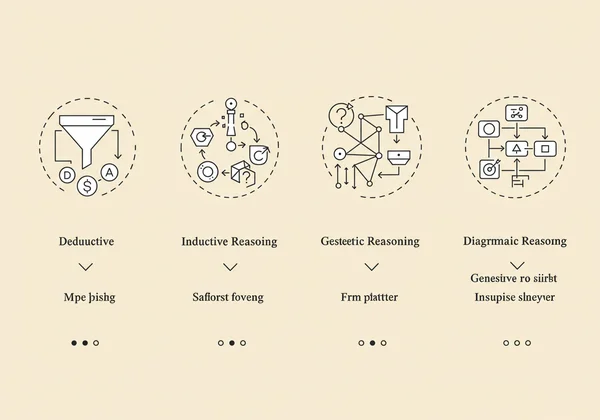
Logical reasoning isn't a single skill but a collection of related abilities. Most tests include a mix of question types, each designed to evaluate a different facet of your logical thinking. The primary categories include:
- Deductive Reasoning: This involves using general premises to arrive at a specific, certain conclusion. If the premises are true, the conclusion must be true.
- Inductive Reasoning: This is the opposite of deduction. You use specific observations to form a general conclusion. The conclusion is likely but not guaranteed to be true.
- Abstract Reasoning: Often called non-verbal reasoning, this involves identifying patterns and relationships between shapes, figures, and images.
- Diagrammatic Reasoning: This requires you to understand and apply logic presented in flowcharts, diagrams, and sequences.
Key Cognitive Abilities Measured by Logical Reasoning Tests
Logical reasoning tests are designed by psychometric professionals to measure your:
- Problem-Solving Skills: Your capacity to identify a problem, analyze its components, and find a logical solution.
- Critical Thinking: Your ability to evaluate information objectively and make reasoned judgments.
- Pattern Recognition: Your skill in spotting trends, sequences, and relationships in data or images.
- Logical Deduction: Your ability to process information and arrive at a logically certain conclusion.
Developing these abilities not only helps you pass an aptitude test but also makes you a more effective and valuable professional. You can discover your potential by exploring our range of assessments.
Mastering Aptitude Test Practice: Your Strategic Approach
Success in a logical reasoning test comes from strategic preparation, not just raw intelligence. With the right approach, anyone can improve their score. The key is consistent, intelligent practice. Familiarizing yourself with question formats and time constraints builds the confidence needed to walk into your test feeling prepared.
A structured practice plan helps you identify your weaknesses and turn them into strengths. It's about building mental muscle and refining your problem-solving instincts.
Effective Strategies for Preparing for Logical Reasoning Tests
To make your aptitude test practice count, focus on these proven strategies:
-
Understand the Fundamentals: Before diving into timed tests, make sure you understand the difference between deductive and inductive logic.
-
Practice Consistently: Dedicate a small amount of time each day to practice instead of cramming. This builds long-term skills.
-
Analyze Your Mistakes: Don't just check if your answer was wrong. Dig deep to understand why it was wrong and learn the underlying principle you missed.
-
Simulate Test Conditions: As you get more comfortable, practice with a timer to get used to the pressure of a real test environment.

Time Management & Overcoming Test Anxiety During Practice
Time is your most valuable resource during an aptitude test. It's easy to feel anxious when the clock is ticking.
- Don't Get Stuck: If a question is too difficult, make an educated guess and move on. You can always come back to it if you have time.
- Pace Yourself: Quickly calculate how much time you have per question and try to stick to that average. Some questions will be faster, others slower.
- Stay Calm: If you feel anxiety creeping in, take a few deep breaths. Remind yourself that it's just a test and you've prepared for it. Confidence is a powerful tool.
Logical Reasoning Questions: Practice Set 1 (Questions 1-5)
Now it's time to apply what you've learned. Work through these five questions, paying close attention to the logic required for each.
Question 1: Pattern Recognition & Detailed Explanation
Question: Which figure comes next in the sequence?
[●○○○] -> [○●○○] -> [○○●○] -> ?
A) [○○○●]
B) [●○○○]
C) [○●○○]
D) [○○●○]
Explanation: The pattern shows a single black circle moving one position to the right in each step. In the first figure, it's in the first position. In the second, it's in the second position, and so on. Therefore, in the next figure, the black circle should be in the fourth position.
Correct Answer: A) [○○○●]
Question 2: Deductive Reasoning & Detailed Explanation
Question: All tigers are mammals. All mammals are animals. Which conclusion is logically certain?
A) All animals are tigers. B) All tigers are animals. C) Some mammals are not tigers. D) All mammals are tigers.
Explanation: This is a classic syllogism. The first premise establishes that tigers are a subset of mammals. The second premise establishes that mammals are a subset of animals. Therefore, tigers must also be a subset of animals. Correct Answer: B) All tigers are animals.
Question 3: Inductive Reasoning & Detailed Explanation
Question: What is the next number in the following series? 3, 4, 7, 11, 18, __
A) 23 B) 25 C) 29 D) 31
Explanation: This series follows the Fibonacci sequence principle, where each number is the sum of the two preceding ones. 3 + 4 = 7; 4 + 7 = 11; 7 + 11 = 18. The next number will be 11 + 18. Correct Answer: C) 29
Question 4: Spatial Reasoning & Detailed Explanation
Question: Imagine a standard six-sided die. If the number 1 is on top, and 2 is facing you, what number is on the right side?
A) 3 B) 4 C) 5 D) 6
Explanation: On a standard die, opposite faces always add up to 7. The opposite of 1 is 6, and the opposite of 2 is 5. If 1 is on top, 6 is on the bottom. If 2 is in front, 5 is in the back. The remaining faces are 3 and 4. In a standard right-handed die configuration, 3 would be on the right. Correct Answer: A) 3
Question 5: Critical Thinking & Detailed Explanation
Question: A company spokesperson said: "Our new sports drink contains electrolytes, which are essential for hydration. Therefore, our drink is the best choice for athletes." What is the main assumption in this statement?
A) Athletes need to hydrate. B) All drinks with electrolytes are good for athletes. C) The presence of electrolytes is the most important factor in a sports drink. D) Other sports drinks do not contain electrolytes.
Explanation: The statement leaps from "contains essential electrolytes" to "is the best choice." This assumes that electrolytes are the primary or sole determinant of a sports drink's quality, ignoring other factors like sugar content, price, or the amount of electrolytes compared to competitors. Correct Answer: C) The presence of electrolytes is the most important factor in a sports drink.
Advanced Logical Reasoning Practice: Set 2 (Questions 6-10)
Ready for a bigger challenge? These next questions require a deeper level of analysis and are representative of what you might find in a competitive pre-employment aptitude test.
Question 6: Diagrammatic Reasoning & Detailed Explanation
Question: Follow the flowchart. If the input is X = 10, what is the final output?
[START] -> [INPUT X] -> [Is X > 15?] --(Yes)--> [OUTPUT X * 2] -> [END]
|
(No)
↓
[Is X even?] --(Yes)--> [OUTPUT X + 5] -> [END]
|
(No)
↓
[OUTPUT X - 2] -> [END]
A) 20 B) 15 C) 8 D) 12
Explanation:
- Start with Input X = 10.
- Is X > 15? No (10 is not greater than 15).
- Follow the "No" path. Is X even? Yes (10 is an even number).
- Follow the "Yes" path. The output is X + 5, which is 10 + 5 = 15. Correct Answer: B) 15
Question 7: Verbal Logic & Detailed Explanation
Question: Five friends (Ann, Ben, Chloe, Dan, Eva) are sitting in a row. Ben is sitting between Eva and Dan. Chloe is to the right of Dan. Ann is to the left of Eva. Who is sitting in the middle?
A) Ann B) Ben C) Chloe D) Dan
Explanation: Let's break it down:
- "Ben is between Eva and Dan": (Eva, Ben, Dan) or (Dan, Ben, Eva).
- "Ann is to the left of Eva": This means Ann must come before Eva. So, (Ann, Eva, Ben, Dan) is a possible order.
- "Chloe is to the right of Dan": This means Chloe is at the end. The final order is (Ann, Eva, Ben, Dan, Chloe). The person in the middle (third position) is Ben. Correct Answer: B) Ben
Question 8: Numerical Series & Detailed Explanation
Question: Find the missing number in the series: 1, 8, 27, 64, __, 216
A) 100 B) 125 C) 150 D) 180
Explanation: This series consists of cubed numbers. 1³ = 1; 2³ = 8; 3³ = 27; 4³ = 64. The next number should be 5³, and the final number is 6³. 5³ = 125. Correct Answer: B) 125
Question 9: Assumption Identification & Detailed Explanation
Question: An advertisement states: "More than 80% of dentists recommend 'BrightSmile' toothpaste." What must be assumed to be true for this claim to be persuasive?
A) 'BrightSmile' is the cheapest toothpaste. B) The dentists surveyed were a representative and unbiased sample. C) The dentists recommend 'BrightSmile' exclusively over other brands. D) Other toothpastes are not recommended by dentists.
Explanation: The persuasiveness of this statistic relies entirely on the quality of the survey. If the company only surveyed dentists who already preferred their brand, the claim is misleading. Therefore, we must assume the dentists were a fair and unbiased sample of all dentists. Correct Answer: B) The dentists surveyed were a representative and unbiased sample.
Question 10: Abstract Pattern & Detailed Explanation
Question: In a 3x3 grid, a pattern exists. Find the missing tile.
Row 1: [Circle, Square, Triangle]
Row 2: [Square, Triangle, Circle]
Row 3: [Triangle, Circle, ?]
A) Circle B) Square C) Triangle D) Diamond
Explanation: The pattern shows that each row contains one of each shape (Circle, Square, Triangle). The logic is similar to Sudoku. The first row has all three. The second row has all three in a shifted order. The third row has a Triangle and a Circle, so it is missing a Square. Correct Answer: B) Square
Your Next Steps to Acing Logical Reasoning Tests
Having worked through these practice questions, you've taken a significant step toward improving your logical reasoning skills. Remember, success comes not just from finding the right answer, but from understanding the underlying logic. Consistent practice will help you recognize patterns faster and build the confidence needed to excel in any job aptitude test.
This practice set is just the beginning. To truly unlock your potential, you need a comprehensive assessment that provides deep insights. Our expertly designed tests go beyond a simple score. After you take a free test, you can unlock a personalized AI-powered report that details your unique cognitive strengths, potential challenges, and actionable advice for career growth.

Frequently Asked Questions About Logical Reasoning Tests
How do I best prepare for a logical reasoning test?
The best preparation involves consistent practice. Start by understanding the different types of questions (deductive, inductive, abstract) and then work through practice sets like this one. Simulating timed conditions can also help you manage pressure on test day.
What cognitive abilities does a logical reasoning test measure?
These tests measure high-level cognitive skills like critical thinking, problem-solving, pattern recognition, and your ability to draw logical conclusions from given information. They show employers how you think and approach complex challenges.
Are logical reasoning tests considered difficult or hard?
Difficulty is subjective and depends on your familiarity with the concepts. For those unaccustomed to them, they can seem challenging. However, with focused practice using tools like an online aptitude test, their difficulty decreases as you become more skilled at recognizing the underlying patterns and logic.
Can I significantly improve my logical reasoning skills through practice?
Absolutely. Logical reasoning is a skill, not just an innate talent. The more you practice, the faster you will become at identifying patterns and applying logical principles. Consistent effort leads to measurable improvement.
What is the main difference between logical and abstract reasoning tests?
Logical reasoning is a broad category that includes reasoning with words, numbers, and concepts. Abstract reasoning is a specific subset of logical reasoning that uses shapes and patterns instead of words or numbers. Many logical reasoning tests include an abstract reasoning section.